

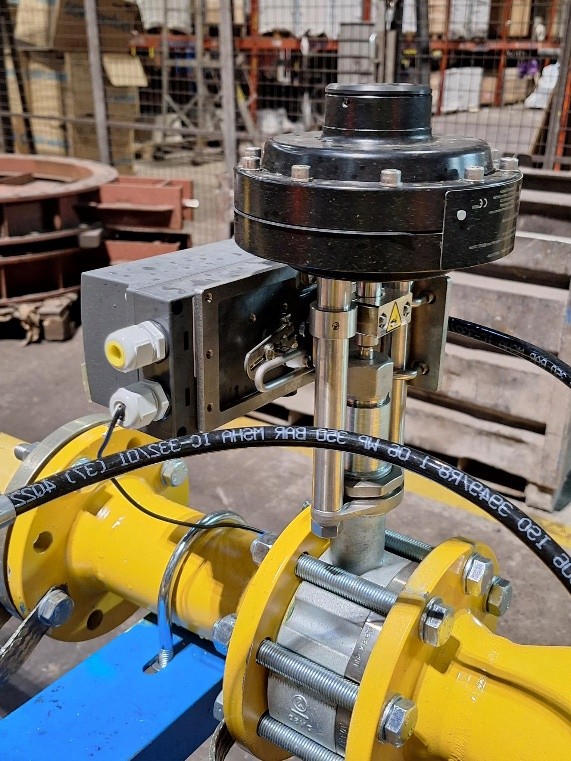
Definition
What is a control valve used for?
A control valve is used to control the flow, pressure, temperature or level of a fluid (gas, liquid or steam) in an industrial circuit. It automatically adjusts its opening to the needs of the process, based on a signal sent by a control system (often a PLC or a controller).


Role
In practice, a control valve makes it possible to:
01
Modulate the flow
Modulate the fluid flow to keep a parameter at a target value (e.g. constant pressure in a pipe).
02
Stabilise the process
Ensure process stability by reacting to variations (temperature, pressure, level…).
03
Optimise
Optimise energy consumption and system safety.
04
Protect
Protect equipment by preventing overpressure and water hammer.
Examples
Examples of use
Thermal power plant
In a thermal power plant, to regulate the steam sent to a turbine.
Chemical plant
In a chemical plant, to dose a reagent precisely.
Heating network
In a heating network, to adapt the hot water flow to demand.
Contact
A control valve to overhaul or adjust?
Our team is available on +32 4 380 59 83 or at info@pkiindustries.be.